How do we actually fix the housing crisis?
Five proven levers are helping cities build more housing, lower costs, and improve affordability.


Table of contents
The middle-income rite of passage of buying a home has somehow disappeared. It’s become unattainable for a shocking (and growing) number of Americans. According to the National Association of Homebuilders, a whopping 74.9% of US households (roughly 100.6 million) could not afford to buy a median-priced new home in 2025.
The highest-paid teachers in Seattle make about $139,000 a year, where a median-priced home requires an income of $219,000. A salary of $124,000 will buy you a home in Nashville, but paramedics there make about $50,000. And in New Orleans, one of the more affordable metro areas in the country, you can buy a home making $75,000 a year, but the city’s firefighters earn about $60,000.
The story goes from bad to worse. Renting is also out of reach for many middle and low-income people in metro neighborhoods. The Harvard Joint Center for Housing Studies found that half of the renters in the country are cost-burdened, spending more than 30% of their income on housing.
Some version of this problem is playing out in cities across the country. The cost of housing is outpacing the growth of incomes at breakneck speed.
Pause for a moment and consider these sobering facts:
According to the Case-Shiller National Index, home prices are up roughly 55 to 60% nationwide since 2019 and still rising.
Research by Clever Real Estate shows median home prices have risen at four times the rate of household incomes since 1960.
Of America's 50 largest metro areas, only three (Pittsburgh, St. Louis, and Detroit) have median home prices that a median-income household can actually afford.
So, why are housing costs rising at this astounding rate? The short answer is: there aren’t enough homes. Estimates say 4 to 7 million more homes are needed across the country. The solution seems obvious: start building. Fast. Yet year after year, the problem compounds. What’s going on?
Well, it’s a messy, difficult world for homebuilders. Their costs have risen about 41% since COVID, driven by raw material prices and a shortage of skilled labor. Their borrowing costs are roughly double what they were in 2021, meaning many projects are no longer viable.
As a result, developers broke ground on about 50% fewer apartments than three years ago. By 2027, the annual number of completed apartments will fall to around 327,000: the lowest level in a decade.
Then there’s the problem of locked-in mortgage rates. During the pandemic, about a quarter of American homeowners locked in rates below 3%, so most aren’t moving anytime soon. This means a huge chunk of existing housing supply for middle-income earners is frozen.
Cities are trying to figure out what levers to pull to reverse the crisis. It’s early to draw big conclusions, but it seems that those with momentum are pulling multiple levers at once.
The middle-income rite of passage of buying a home has somehow disappeared. It’s become unattainable for a shocking (and growing) number of Americans. According to the National Association of Homebuilders, a whopping 74.9% of US households (roughly 100.6 million) could not afford to buy a median-priced new home in 2025.
The highest-paid teachers in Seattle make about $139,000 a year, where a median-priced home requires an income of $219,000. A salary of $124,000 will buy you a home in Nashville, but paramedics there make about $50,000. And in New Orleans, one of the more affordable metro areas in the country, you can buy a home making $75,000 a year, but the city’s firefighters earn about $60,000.
The story goes from bad to worse. Renting is also out of reach for many middle and low-income people in metro neighborhoods. The Harvard Joint Center for Housing Studies found that half of the renters in the country are cost-burdened, spending more than 30% of their income on housing.
Some version of this problem is playing out in cities across the country. The cost of housing is outpacing the growth of incomes at breakneck speed.
Pause for a moment and consider these sobering facts:
According to the Case-Shiller National Index, home prices are up roughly 55 to 60% nationwide since 2019 and still rising.
Research by Clever Real Estate shows median home prices have risen at four times the rate of household incomes since 1960.
Of America's 50 largest metro areas, only three (Pittsburgh, St. Louis, and Detroit) have median home prices that a median-income household can actually afford.
So, why are housing costs rising at this astounding rate? The short answer is: there aren’t enough homes. Estimates say 4 to 7 million more homes are needed across the country. The solution seems obvious: start building. Fast. Yet year after year, the problem compounds. What’s going on?
Well, it’s a messy, difficult world for homebuilders. Their costs have risen about 41% since COVID, driven by raw material prices and a shortage of skilled labor. Their borrowing costs are roughly double what they were in 2021, meaning many projects are no longer viable.
As a result, developers broke ground on about 50% fewer apartments than three years ago. By 2027, the annual number of completed apartments will fall to around 327,000: the lowest level in a decade.
Then there’s the problem of locked-in mortgage rates. During the pandemic, about a quarter of American homeowners locked in rates below 3%, so most aren’t moving anytime soon. This means a huge chunk of existing housing supply for middle-income earners is frozen.
Cities are trying to figure out what levers to pull to reverse the crisis. It’s early to draw big conclusions, but it seems that those with momentum are pulling multiple levers at once.

Zoning
In many American cities, it is literally illegal to build a duplex — 75% of urban residential land is zoned exclusively for single-family homes. This means new duplexes, triplexes, and small apartment buildings have been mostly legislated out of existence. These are the starter homes that let families put down roots and start building equity.
Minneapolis was the first major city to push back. Its 2040 Plan eliminated single-family zoning entirely, allowing duplexes and triplexes on every residential lot. According to research by Pew Charitable Trusts, between 2017 and 2022, Minneapolis expanded its housing stock by 12% (roughly 21,000 new units) while the rest of Minnesota grew by just 4%. Rents rose only 1% over that period. Homelessness in Hennepin County fell 12%, while rising 14% statewide.
Zoning
In many American cities, it is literally illegal to build a duplex — 75% of urban residential land is zoned exclusively for single-family homes. This means new duplexes, triplexes, and small apartment buildings have been mostly legislated out of existence. These are the starter homes that let families put down roots and start building equity.
Minneapolis was the first major city to push back. Its 2040 Plan eliminated single-family zoning entirely, allowing duplexes and triplexes on every residential lot. According to research by Pew Charitable Trusts, between 2017 and 2022, Minneapolis expanded its housing stock by 12% (roughly 21,000 new units) while the rest of Minnesota grew by just 4%. Rents rose only 1% over that period. Homelessness in Hennepin County fell 12%, while rising 14% statewide.
Parking
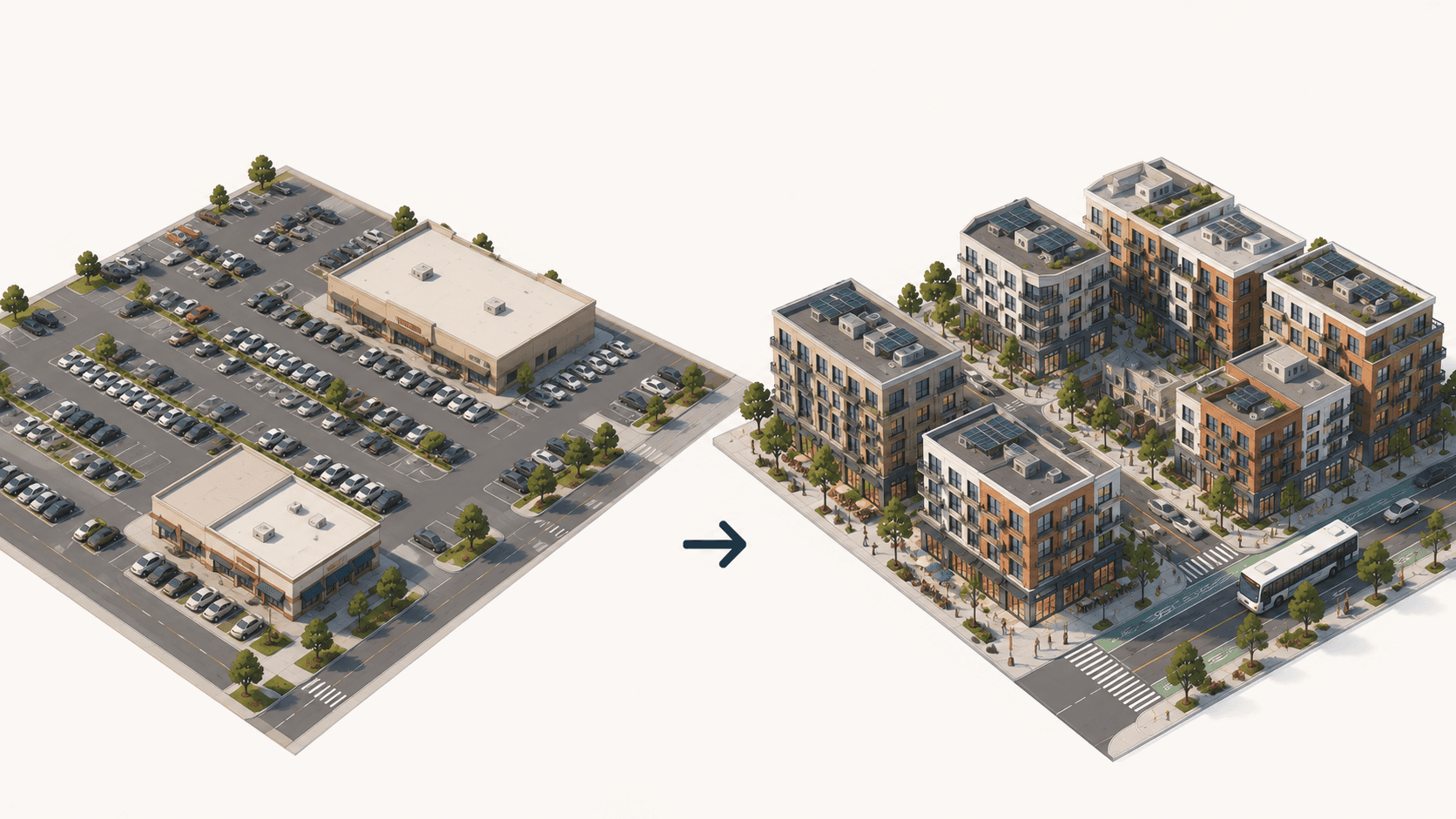
Parking doesn't sound like a housing issue until you crunch the numbers. Mandatory parking minimums have been inflating construction costs for decades. These rules force developers to build a set number of spaces per unit, regardless of whether residents own cars or live near transit. Some cities have been requiring two and a half times more parking than peak demand warrants.
UCLA Institute of Transportation Studies reports that an aboveground parking space costs an average of $52,000 to build. Underground averages $73,000. For a studio apartment, that can raise the cost up to 39%.
Minneapolis eliminated its minimums in 2021. Rents declined 4% over a period when national rents rose 22%.
The parking fix requires no new spending (assuming public transit is in place), and no new legislation in most cases.
Parking
Parking doesn't sound like a housing issue until you crunch the numbers. Mandatory parking minimums have been inflating construction costs for decades. These rules force developers to build a set number of spaces per unit, regardless of whether residents own cars or live near transit. Some cities have been requiring two and a half times more parking than peak demand warrants.
UCLA Institute of Transportation Studies reports that an aboveground parking space costs an average of $52,000 to build. Underground averages $73,000. For a studio apartment, that can raise the cost up to 39%.
Minneapolis eliminated its minimums in 2021. Rents declined 4% over a period when national rents rose 22%.
The parking fix requires no new spending (assuming public transit is in place), and no new legislation in most cases.
Financing
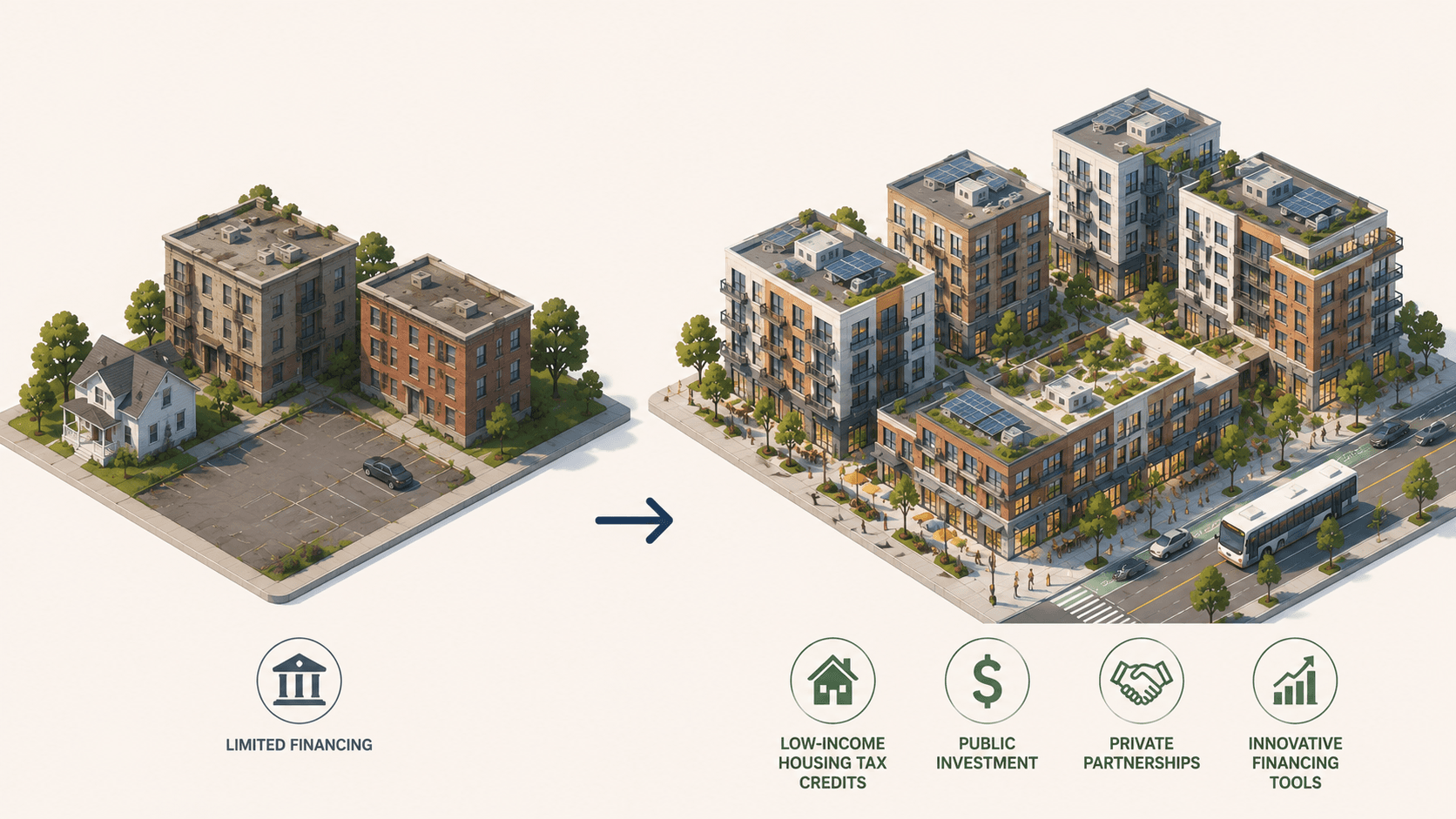
Building affordable housing costs roughly the same as building market-rate housing. Land, labor, materials, and financing rates don't change just because residents earn less. Public financing exists to close the gap between what it costs to build and what working families can pay.
Austin shows what that looks like at scale. Pew Charitable Trusts reported that a voter-approved $250 million housing bond, combined with zoning reform and permitting improvements, helped the city add 120,000 new units between 2015 and 2024. Inflation-adjusted rents fell 19% from their 2021 peak.
Federal tax credit programs exist specifically to subsidize affordable housing, but they're chronically underfunded, so cities have to stack multiple funding sources to make a project viable. It's a workaround, but it gets the job done.
Financing
Building affordable housing costs roughly the same as building market-rate housing. Land, labor, materials, and financing rates don't change just because residents earn less. Public financing exists to close the gap between what it costs to build and what working families can pay.
Austin shows what that looks like at scale. Pew Charitable Trusts reported that a voter-approved $250 million housing bond, combined with zoning reform and permitting improvements, helped the city add 120,000 new units between 2015 and 2024. Inflation-adjusted rents fell 19% from their 2021 peak.
Federal tax credit programs exist specifically to subsidize affordable housing, but they're chronically underfunded, so cities have to stack multiple funding sources to make a project viable. It's a workaround, but it gets the job done.
Permitting
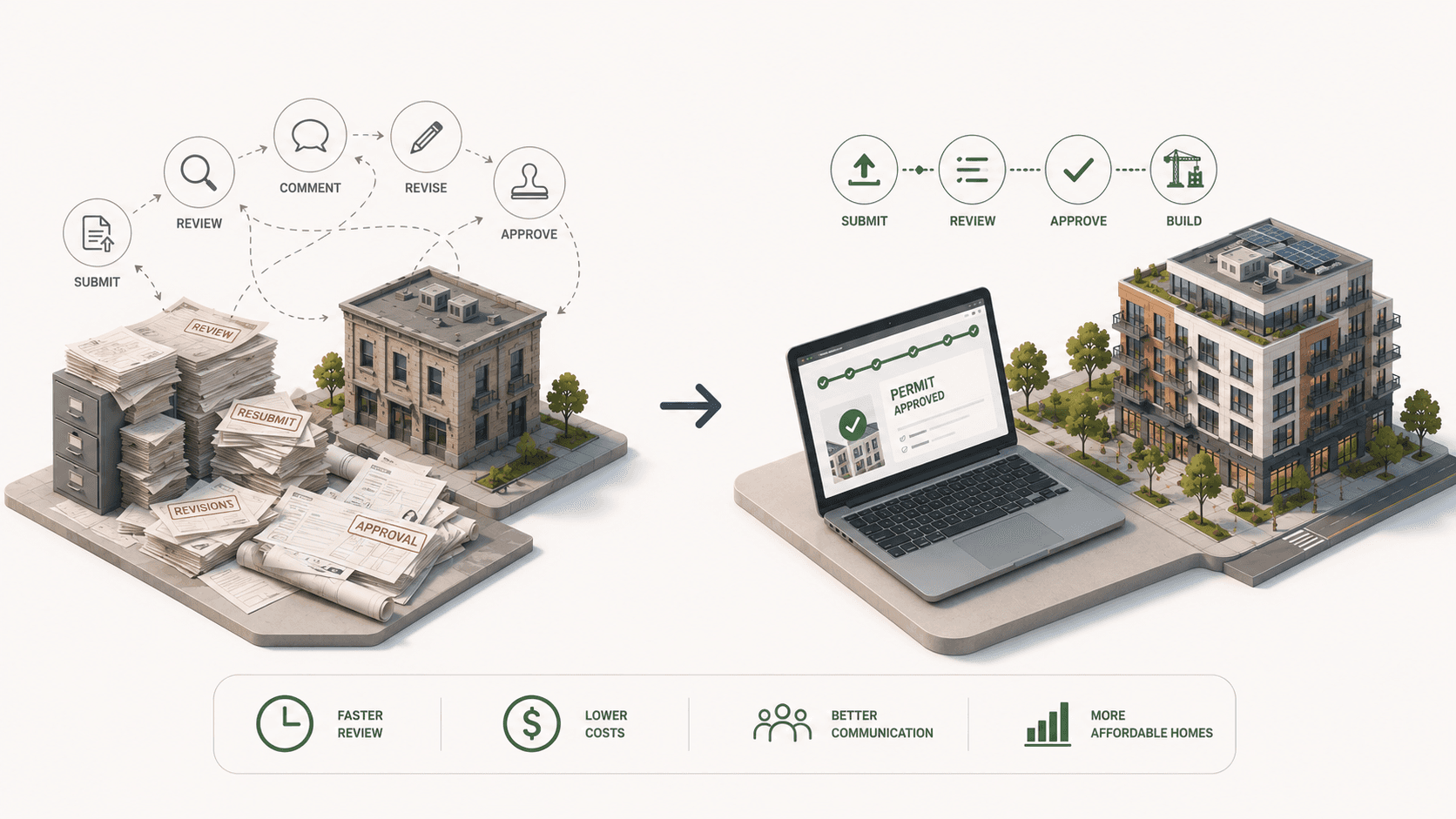
A project can survive zoning and financing hurdles and still die a tragic death waiting for a permit. A recent LA County study found that slow permitting can add over 30% to development costs and stretch timelines by two years. Carrying costs accumulate month after month until eventually the math stops working. Projects simply get shelved.
Most people don't know that the permitting bottleneck starts before the city ever touches an application. Up to 70% of applications arrive incomplete or inaccurate. City staff wind up investing inordinate amounts of time hand-holding permit seekers, helping them complete applications. In the meantime, the whole system gets jammed up.
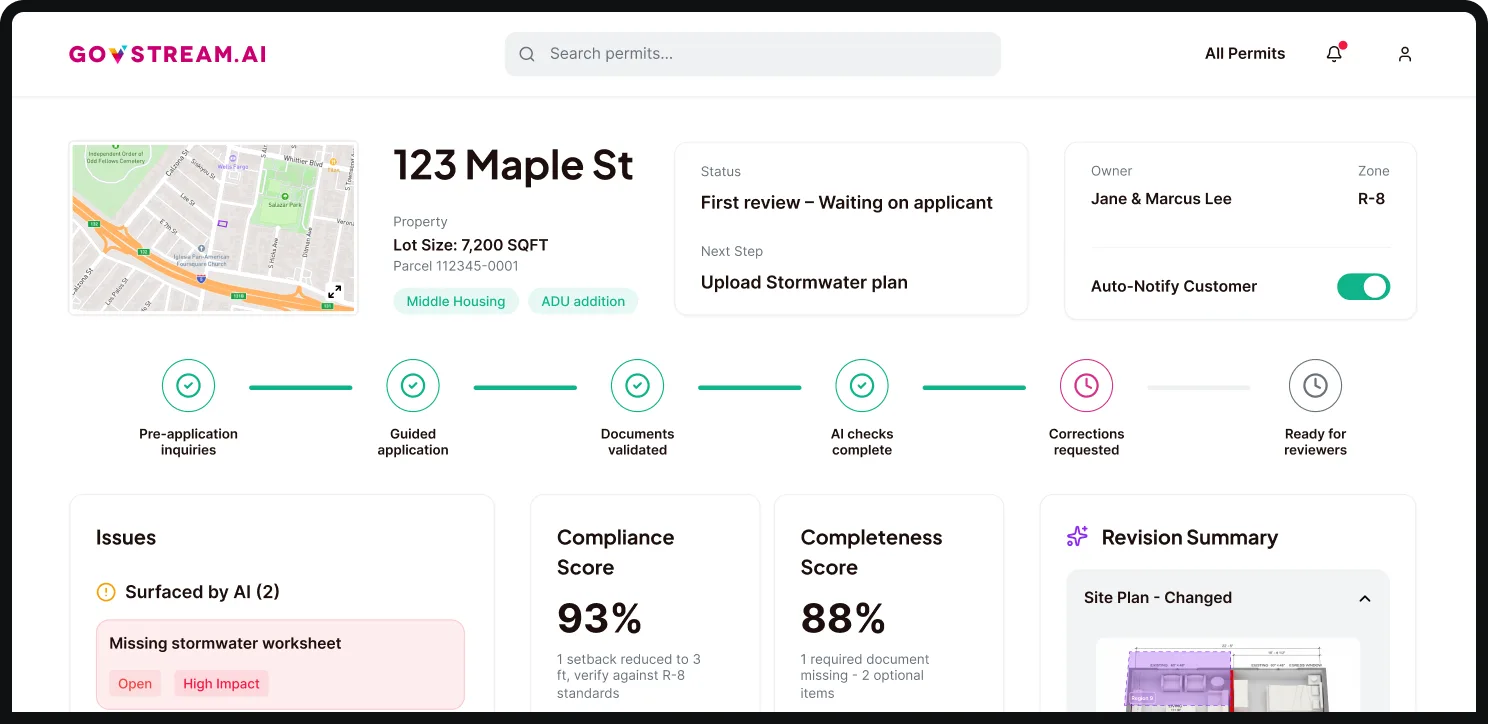
Cities are attacking the problem from different angles. Prince George's County, Maryland is shifting from sequential review to simultaneous, so that multiple departments assess a project at once. Louisville is working with Govstream.ai to pilot technology-assisted workflows that help permit-seekers fill out their submissions. In Bellevue, Washington, an early ‘intelligent’ tech-enabled permitting pilot has already cut inbound applicant questions by 30% in three months.
As we see, permitting can be modernized so city staff are freed up to do the strategic work of reviewing and approving applications, rather than chasing down missing paperwork.
Permitting
A project can survive zoning and financing hurdles and still die a tragic death waiting for a permit. A recent LA County study found that slow permitting can add over 30% to development costs and stretch timelines by two years. Carrying costs accumulate month after month until eventually the math stops working. Projects simply get shelved.
Most people don't know that the permitting bottleneck starts before the city ever touches an application. Up to 70% of applications arrive incomplete or inaccurate. City staff wind up investing inordinate amounts of time hand-holding permit seekers, helping them complete applications. In the meantime, the whole system gets jammed up.
Cities are attacking the problem from different angles. Prince George's County, Maryland is shifting from sequential review to simultaneous, so that multiple departments assess a project at once. Louisville is working with Govstream.ai to pilot technology-assisted workflows that help permit-seekers fill out their submissions. In Bellevue, Washington, an early ‘intelligent’ tech-enabled permitting pilot has already cut inbound applicant questions by 30% in three months.
As we see, permitting can be modernized so city staff are freed up to do the strategic work of reviewing and approving applications, rather than chasing down missing paperwork.

Wages and Income
Four decades of wage stagnation are the undercurrent beneath everything else on this list. Adjusted for inflation, median wages have grown less than 0.6% a year since 1979. Incomes at the top have risen sharply, bidding up home prices and rents for everyone below them. Housing got expensive while most workers lost the ability to compete for it.
Cities can't set wages, but they do have tools at their disposal. Community land trusts permanently shield homes from market-rate pressure. Income-restricted units and housing vouchers tie costs to what residents actually earn. Employer-assisted housing partnerships bring the region's biggest payrolls into the solution. Tools like these help make housing financially accessible to working families, so that cities aren’t building homes people can’t afford.
Wages and Income
Four decades of wage stagnation are the undercurrent beneath everything else on this list. Adjusted for inflation, median wages have grown less than 0.6% a year since 1979. Incomes at the top have risen sharply, bidding up home prices and rents for everyone below them. Housing got expensive while most workers lost the ability to compete for it.
Cities can't set wages, but they do have tools at their disposal. Community land trusts permanently shield homes from market-rate pressure. Income-restricted units and housing vouchers tie costs to what residents actually earn. Employer-assisted housing partnerships bring the region's biggest payrolls into the solution. Tools like these help make housing financially accessible to working families, so that cities aren’t building homes people can’t afford.

The Hard Part
The five levers (zone, parking, financing, permitting, wages/income) are tested and proven. So why haven't more cities pulled them?
The answer lies in a hard truth: the housing crisis isn’t a crisis for everyone. For people priced out of their cities or trying to buy their first home, it's a crisis. For homeowners, decades of housing scarcity have meant steady appreciation and wealth accumulation. Cities are in the delicate position of serving and answering to both groups.
And it must be noted that homeowners vote in local elections at far higher rates than renters, which means cities often face opposition to housing reform from the constituents with the most power to stop it.
On top of that, cities face state preemption laws that limit zoning authority, chronically underfunded permitting departments, and federal programs sized for a smaller problem. It’s no wonder many feel suffocated by the crisis.
Yet some are taking action anyway. Minneapolis passed its 2040 Plan over loud opposition. Austin's voters approved a quarter-billion-dollar housing bond. How those cities built enough political support to act, when so many others stalled, is a question we'll take up in another piece.
The Hard Part
The five levers (zone, parking, financing, permitting, wages/income) are tested and proven. So why haven't more cities pulled them?
The answer lies in a hard truth: the housing crisis isn’t a crisis for everyone. For people priced out of their cities or trying to buy their first home, it's a crisis. For homeowners, decades of housing scarcity have meant steady appreciation and wealth accumulation. Cities are in the delicate position of serving and answering to both groups.
And it must be noted that homeowners vote in local elections at far higher rates than renters, which means cities often face opposition to housing reform from the constituents with the most power to stop it.
On top of that, cities face state preemption laws that limit zoning authority, chronically underfunded permitting departments, and federal programs sized for a smaller problem. It’s no wonder many feel suffocated by the crisis.
Yet some are taking action anyway. Minneapolis passed its 2040 Plan over loud opposition. Austin's voters approved a quarter-billion-dollar housing bond. How those cities built enough political support to act, when so many others stalled, is a question we'll take up in another piece.
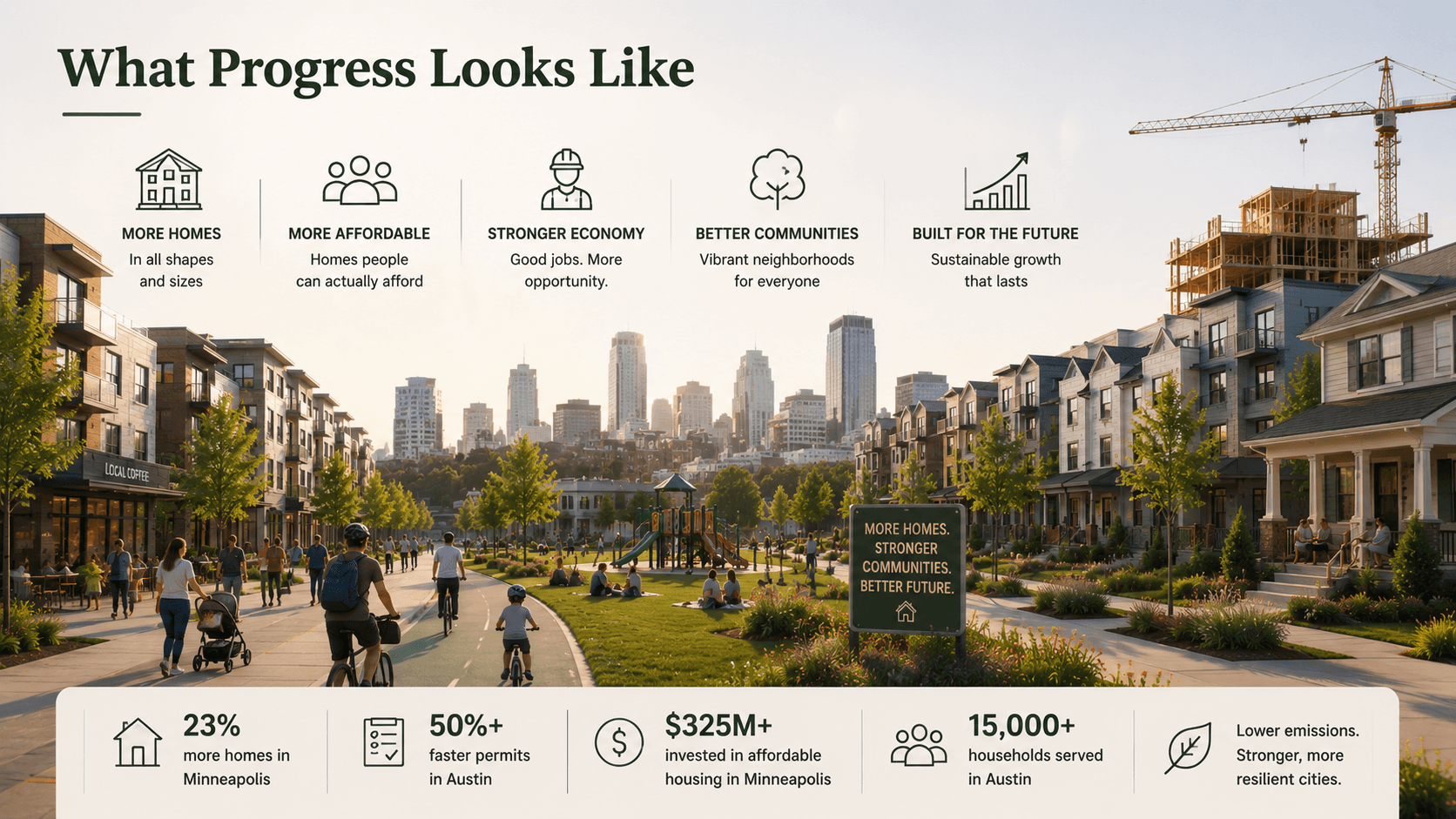
What Progress Looks Like
No city has fully solved this. But Minneapolis and Austin have shown that pulling multiple levers at once creates momentum.
Picture where this leads. A teacher who works downtown rents three miles from her school instead of 45 minutes away. Her building, a charming six-unit walkup on a block that once allowed only single-family homes, took six months to permit instead of three years. Her rent is tied to what she earns. The developer skipped the parking structure nobody wanted, and a city housing fund covered the gap between what the project cost and what tenants can pay.
We’ll keep exploring what it'll take to solve the housing crisis. Some cities are making real headway, and the rest of this series will take a look at what they're learning.
Sources:
________________________________________________________________________
Govstream.ai builds intelligent AI-powered permitting workflows for cities and counties. Our platform brings continuous feedback, intelligent routing, and real-time decision support to every stage of the permitting process to support staff and guide builders.
What Progress Looks Like
No city has fully solved this. But Minneapolis and Austin have shown that pulling multiple levers at once creates momentum.
Picture where this leads. A teacher who works downtown rents three miles from her school instead of 45 minutes away. Her building, a charming six-unit walkup on a block that once allowed only single-family homes, took six months to permit instead of three years. Her rent is tied to what she earns. The developer skipped the parking structure nobody wanted, and a city housing fund covered the gap between what the project cost and what tenants can pay.
We’ll keep exploring what it'll take to solve the housing crisis. Some cities are making real headway, and the rest of this series will take a look at what they're learning.
Sources:
________________________________________________________________________
Govstream.ai builds intelligent AI-powered permitting workflows for cities and counties. Our platform brings continuous feedback, intelligent routing, and real-time decision support to every stage of the permitting process to support staff and guide builders.

Modern permitting
for growing cities
Modern permitting for growing cities
Govstream.ai helps cities modernize permitting, improve efficiency, and support sustainable growth.
Govstream.ai helps cities modernize permitting, improve efficiency, and support sustainable growth.